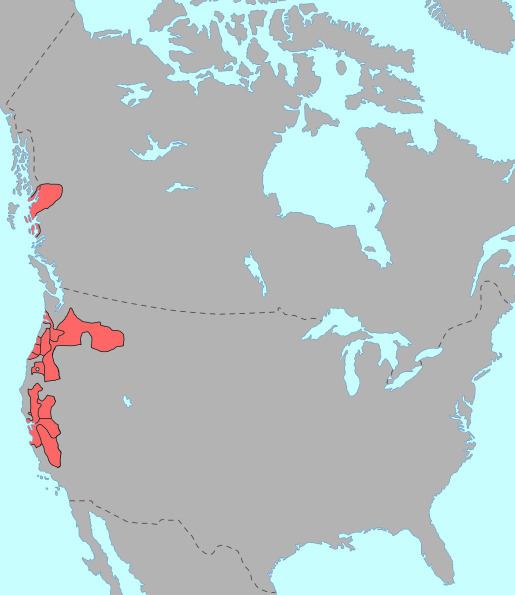
Plateau Penutian (also Shahapwailutan, Lepitan) is a proposed family of languages spoken in northern California, reaching through central-western Oregon to northern Washington and central-northern Idaho.
Family division
Plateau Penutian is hypothesized to consist of four languages:
History of proposal
Plateau Penutian, as originally proposed, was one branch of the hypothetical Penutian phylum as proposed by Edward Sapir. The original proposal also included Cayuse (which was grouped with Molala into a Waiilatpuan branch); however, this language has little documentation and that which is documented is inadequately recorded. Thus, the status of Cayuse within Penutian (or any other genealogical relation for that matter) may very well forever remain unclassified.
The Sahaptian grouping of Sahaptin and Nez Percé has long been uncontroversial. There is evidence in support of a connection between Klamath (a.k.a. Klamath-Modoc) and Sahaptian. Howard Berman also provides evidence that would include Molala within Plateau Penutian.
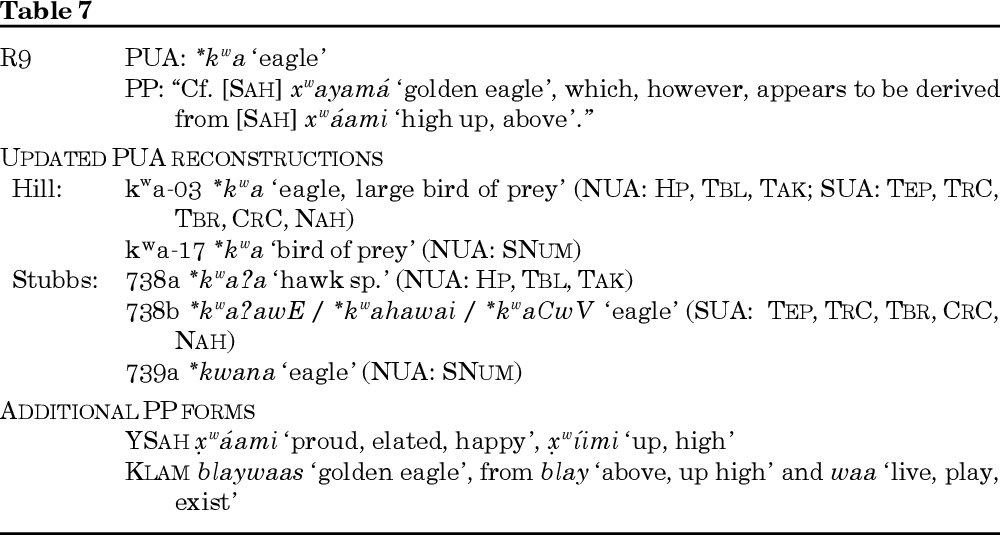
Appraisals of the Penutian hypothesis in the 90s find Plateau Penutian to be "well supported" (DeLancey & Golla (1997: 181); Campbell 1997), with DeLancey & Golla (1997: 180) cautiously stating "while all subgroupings at this stage of Penutian research must be considered provisional, several linkages show considerable promise" (Campbell 1997 likewise mentions similar caveats). Other researchers have pointed out similarities between Plateau Penutian and the Maiduan family, although this proposal is still not completely demonstrated. A connection with Uto-Aztecan has also been suggested (Rude 2000). The Glottolog classification, favored by many linguistic typologists but considered too conservative by some, disregards Plateau Penutian entirely.
Computational analyses and the Comparative Method
A study published in 2013 using an automated computational analysis (ASJP 4) of 40 basic vocabulary items resulted in languages from Plateau Penutian showing similarities that could be interpreted as genealogical cohesion. However, when describing the method, the authors of the study also concede that similarities may be due to borrowings and areal diffusion. Moreover, the use of automated methods for establishing genealogical connections is controversial, with many historical linguistics still favouring analyses using the comparative method, which places high importance on morphological similarities, especially when found in irregularities (e.g. English good-better-best, German gut-besser-best, Icelandic góður-betri-bestur).
Vocabulary
Below is a comparison of selected basic vocabulary items in Proto-Sahaptian, Klamath, and Molala †.
- Abbreviations
- S = Sahaptian
- N = Nez Percé
References
Bibliography
- Campbell, Lyle. (1997). American Indian languages: The historical linguistics of Native America. New York: Oxford University Press. ISBN 0-19-509427-1.
- Campbell, Lyle; & Mithun, Marianne (Eds.). (1979). The languages of native America: Historical and comparative assessment. Austin: University of Texas Press.
- DeLancey, Scott; & Golla, Victor. (1997). The Penutian hypothesis: Retrospect and prospect. International Journal of American Linguistics, 63, 171–202.
- Goddard, Ives (Ed.). (1996). Languages. Handbook of North American Indians (W. C. Sturtevant, General Ed.) (Vol. 17). Washington, D. C.: Smithsonian Institution. ISBN 0-16-048774-9.
- Goddard, Ives. (1999). Native languages and language families of North America (rev. and enlarged ed. with additions and corrections). [Map]. Lincoln, NE: University of Nebraska Press (Smithsonian Institution). (Updated version of the map in Goddard 1996). ISBN 0-8032-9271-6.
- Mithun, Marianne. (1999). The languages of Native North America. Cambridge: Cambridge University Press. ISBN 0-521-23228-7 (hbk); ISBN 0-521-29875-X.
- Rude, Noel. (1987). "Some Sahaptian-Klamath grammatical correspondences." Kansas Working Papers in Linguistics, 12:67-83.
- Rude, Noel. (2000). Some Uto-Aztecan-Plateau Grammatical Comparisons. In Uto-Aztecan: Structural, Temporal, and Geographic Perspectives: Papers in Memory of Wick R. Miller by the Friends of Uto-Aztecan, edited by Eugene H. Casad and Thomas L. Willet, pp. 309–318. Hermosillo, Sonora, México: Editorial UniSon.
- Sapir, Edward. (1929). Central and North American languages. In The encyclopædia britannica: A new survey of universal knowledge (14 ed.) (Vol. 5, pp. 138–141). London: The Encyclopædia Britannica Company, Ltd.